The Kolkata Bat Waiting for a Bus
Acronyms expanded in this post:
- COVID: Coronavirus Disease. the disease caused by SARS-CoV-2.
Kolkata public transport is less a system than a recurring experiment in how many vertebrates can be folded into a moving container before somebody invokes God, Marx, bad breath, or the ancestry of the man blocking the door.
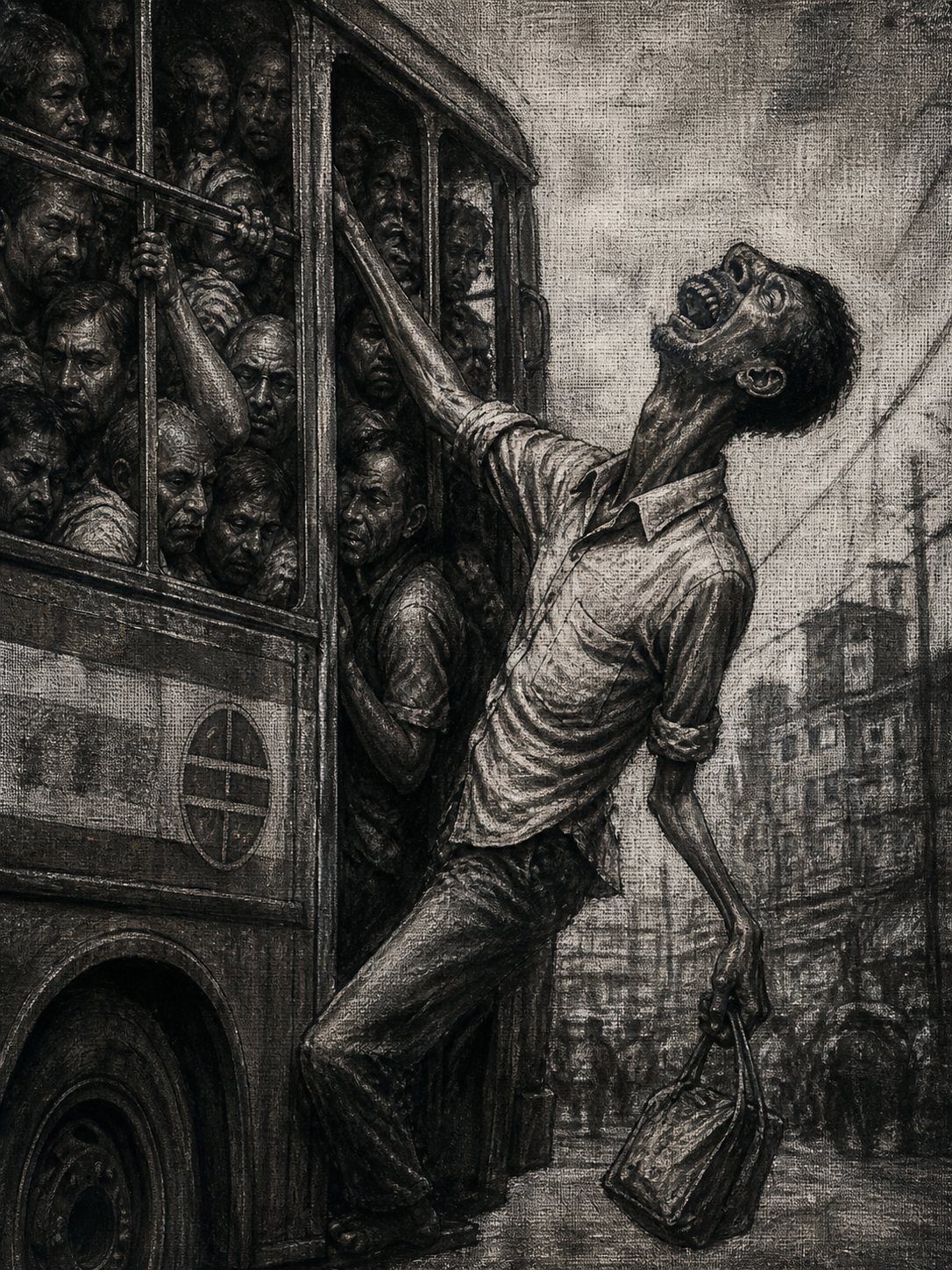
When I was in school, there was a Horlicks television commercial that caught this better than any government brochure, transport study, or solemn urban mobility conference ever could. It showed overcrowded Kolkata bus travel as a kind of bat colony with fares. People were not seated or standing so much as suspended. They clung to rods, corners, ledges, straps, one another, and possibly the last moral thread connecting civilization to the Stone Age. The joke worked because it was hardly a joke. It was documentary realism with better lighting.
I still remember the image of the Bengali bat: shirted, bagged, weary, faintly clerical, carrying a briefcase in one wing and a biri in the mouth, that little hand-rolled cigarette of democratic ruin. He was not ashamed. Why should he be? Shame is for people who have space to turn around and consider their condition. The man-bat simply approached the bus, judged the geometry of humiliation, spread his wings with the resignation of a minor civil servant, and inserted himself into a gap no larger than a philosophical disagreement.
Somehow he made it.
One claw on the metal handle. One wing out. One bag crushed. One biri still glowing. A commuter, in other words.
The old bus has now acquired descendants. The same theatre plays out in the Kolkata Metro Rail [urban rapid transit system, theoretically designed to move large numbers of passengers efficiently], only with more fluorescent lighting and a firmer belief among passengers that everyone else is behaving incorrectly. Fights break out over propriety, elbows, body odor, halitosis, political affiliation, bag size, proximity to the door, who entered first, who should have moved, who did not move, who touched whom, who breathed too democratically, who released a fart with inadequate apology, and who appears to be the illegitimate progeny of livestock banned by statute, custom, or family preference.
The Coronavirus Disease 2019 [COVID-19, the respiratory pandemic that briefly made public coughing a matter of geopolitical seriousness] stickers are still there in many places, like fossils from a more theatrical age of panic. They continue to warn passengers about COVID-appropriate behavior, a phrase that now feels like something recovered from a sunken ministry file. Everybody reads it while pressing into everybody else with the intimacy of boiled noodles in a tiffin box.
This is one of the great civic talents of India: the conversion of abandoned instruction into permanent wallpaper. A rule arrives, fails, fades, peels, and remains. It is not removed because removing it requires work. It is not obeyed because obeying it requires a society. So there it stays, a sticker from the age of masks, asking a compartment of compressed strangers to maintain distance while one man’s backpack is conducting a full archaeological survey of another man’s ribs.
Accidents, of course, are never quite the issue because statistics are not quite statistics. A number here is less a measured fact than a nervous animal, easily frightened by political pressure, bribery, administrative inconvenience, or the dangerous possibility that someone may ask who was responsible. The tally has holes. Digits enter and escape according to heat, influence, paperwork, and the local gravitational field of power.
Safety is not absent exactly. It is more like a distant relative mentioned during weddings. Everyone agrees it exists. Everyone says it should be respected. Nobody wants to pay for its train ticket.
You discover its importance only when you are already in midair, falling into a ditch, at which point policy has become physics and physics is famously poor at accepting petitions. Two-wheeler casualties are so common that the road seems to conduct a daily seminar on skull fragility. Helmets are treated as optional ornaments until the head meets the street and the brain, that soft custard of memory, debt, lust, arithmetic, song lyrics, and unresolved family anger, attempts an unscheduled exit.
The same logic runs through business. Many local enterprises are not built on fundamentals but on evasions arranged in the shape of fundamentals. They survive by underpaying, delaying, misreporting, hiding, bending, flattering, bribing, exploiting, and then calling the whole wobbling contraption entrepreneurship. The signboard says company. The bloodstream says loophole.
A good chartered accountant [CA, the professional who handles accounting, taxation, auditing, and financial compliance] in such an ecosystem is not merely a keeper of books. He is a priest of plausible falsehood. He knows where the numbers can be softened, where the dates can be massaged, where the liabilities can be encouraged to take a long walk into the fog. Some CAs are honest, certainly. But the system has use for honesty in the same way a fish market has use for sandalwood incense: decorative, doomed, and quickly overpowered.
What many people actually pay for is not accounting. It is camouflage. The books must look sufficiently book-like to pass through the digestive tract of the state. Salaries, taxes, compliance, documentation, worker rights, vendor dues, statutory obligations—these are not treated as structural commitments but as irritations, small moral mosquitoes buzzing around the sleeping elephant of profit.
Paying salaries is considered an especially vulgar interruption. Many employers speak of salary as if it were a mysterious monsoon failure, something unfortunate but atmospheric. The work has happened, yes. The employee has appeared, sweated, obeyed, delivered, swallowed insult, sacrificed weekends, answered calls, and aged visibly under tube light. But salary? Salary requires further reflection. Salary must be discussed after cash flow improves, after the client pays, after the festival, after the election, after the audit, after the owner’s nephew returns from Dubai, after the sun cools, after the Ganga reverses direction and apologizes to Bihar.
There is often no clean relationship between job and wage, labor and dignity, time and payment. In many parts of the private economy, especially outside the competitive islands where multinational companies must fight for software talent, compensation is a mood. A bracket is not declared. A floor is not enforced. A promise is not binding. The employee learns the old lesson: in theory, he has a profession; in practice, he has been rented by a mood disorder wearing formal shoes.
This is why corruption is never merely a moral defect. It becomes architecture. It is built into the way buses are packed, roads are crossed, salaries are delayed, books are cooked, rules are posted, taxes are avoided, and blame is distributed like cheap sweets during a political rally. Nobody owns the whole failure, which is convenient because everybody owns a little of it. The links in the chain are rusty, but the chain still moves. That is the terrible part. Collapse would be honest. Functioning decay is harder to indict.
When I was young, I did not understand this. I mistook paperwork for order, employment for legitimacy, signatures for accountability, and adult confidence for knowledge. I thought systems were badly run because people had not yet learned to run them well. Age is useful chiefly because it beats that optimism with a wet umbrella until it stops singing.
Now I know better. A bad system is often not waiting to be improved. It is already serving someone. The overcrowded bus serves someone. The ignored rule serves someone. The unpaid salary serves someone. The missing statistic serves someone. The fake invoice, the pliable ledger, the sleeping inspector, the heroic commuter hanging diagonally from a handle with one shoe on the step and one ancestor in heaven—all of it serves someone.
Just not the person inside it.
So I have changed. The gullible young man has become a vigilant, crusty cynic bat. I wait for the bus with my invisible wings folded, my bag clutched, my suspicion polished to a professional sheen. I no longer ask whether the system will make room. I ask what lie it will require from me before pretending that I have been accommodated.
Thomas Malthus [English economist known for arguing that population growth can outrun available resources] worried that human beings would multiply faster than their means of subsistence. He spoke of food, land, hunger, and the grim arithmetic of survival. But he did not live long enough to see his theorem perfected in Kolkata at 8:45 on a weekday morning, when three hundred people attempt to board a vehicle designed for the moral development of forty-seven.
Still, one must give the old pessimist credit. He understood the basic plot. Too many bodies. Too little space. Too few resources. Too much confidence from those who will not be crushed.
He was right, I must admit.
He simply forgot to include the biri.